• Zur Metanavigation
  • Zur Hauptnavigation
  • Zur Suche
  • Zum Inhalt
  • Zur Subnavigation
  • Zum Seitenfuß
  • University of Hamburg
  • For journalists
  • Staff Service Portal0
  • STiNE
https://www.kus.uni-hamburg.de/aktuelles.json?recentnews=true
  • Institutions and target groups
    • Einrichtungen
      • Faculties

        • Faculty of Law
        • Faculty of Business, Economics and Social Sciences
        • Faculty of Medicine
        • Faculty of Education
        • Faculty of Humanities
        • Faculty of Mathematics, Informatics and Natural Sciences
        • Faculty of Psychology and Human Movement Science
        • University of Hamburg Business School
      • Services

        • Study Information Net STiNE
        • Surfmail
        • Exchange
        • Staff Service Portal
        • Learning Platforms
        • Katalogplus – Catalogue of Hamburg Libraries
        • SharePoint
      • Student facilities and services

        • Campus Center
        • Career Center
        • PIASTA
        • AStA (student council)
        • University Sports
        • University Music
        • Family Office
        • University Language Center
        • General Languages
        • Office of Affairs for Students with Disabilities or Chronic Diseases
        • Departmental libraries
        • Healthy Campus
      • Further facilities and services

        • The Cluster of Excellence CLICCS
        • The Cluster of Excellence CUI
        • The Cluster of Excellence Quantum Universe
        • The Cluster of Excellence Understanding Written Artefacts
        • Hamburg Research Academy
        • Pier Plus
        • Hamburg Center for University Teaching and Learning (HUL)
        • Hub for Crossdisciplinary Learning (HCL)
        • CEN
        • Museums and collections
        • University Archives (in German)
        • Regional Computing Center (RRZ)
        • University Administration
        • Knowledge Exchange Agency
        • The Unikontor Shop (in German)
    • Target groups

      • Prospective students
      • Students
      • International prospective students
      • Young researchers
      • Researchers
      • Instructors
      • Staff
      • Prospective continuing education students
      • Alumni
      • Journalists
      • Refugees (in German only)
    Close
  • /sitemap.json
University of Hamburg - to research, to teach, to educate and form, to homepage
profiling-guide-alt

    Photo: CSMC

    1. UHH
    2. CSMC
    3. profiling-guide-alt
    4. alt-types
    5. Pothi

    Pothi

    Giovanni Ciotti
    CSMC

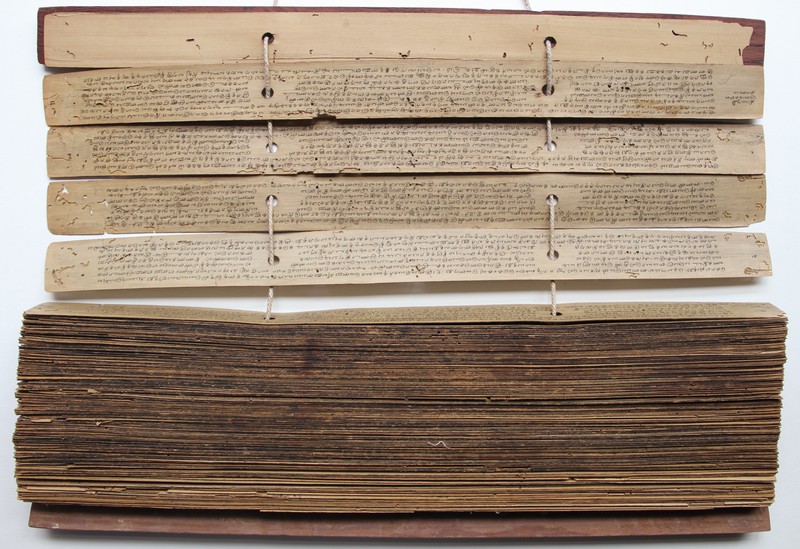
    Palm-leaf pothi from South-India.

    The term ‘pothi’ (pothī) can be used as an umbrella term for any manuscript that is made of a stack of folios in landscape format that are flipped upward rather than sideward (such that the writing on the verso would be upside down if the folios were to be flipped sideward). Historically, this form was prominently used in South and Southeast Asia as well as Tibet, but also to a lesser extent in other areas of Central Asia (where very rarely the folio orientation can happen to be in portrait format and the flipping sideward) (Ciotti 2021, Galambos 2020, 25–27).

    The folios of pothis can be made of a great variety of materials. The most commonly used were the leaves of different palm-trees (Talipot and Palmyra), the bark of various trees (Birch and Agarwood tree) and several kinds of handmade paper. More rarely, folios were made of silk, leather, poplar wood, metal sheets (silver, brass and tin) and ivory (Ciotti 2021).

    The most sophisticated folio processing happens in the case of the so-called kammavaca manuscripts (kammavācā, “words for the ritual”), i.e. Burmese pothis produced at the occasion of the ordination of a new Buddhist monk. The folios of some of these manuscripts are made either with palm-leaves or textiles that are first stiffened by applying layers of clay and lacquer and then gilded and finally written upon with lacquer (Isaacs 2014, 34; Ward 2015, 72).

    The folios of a pothi can be strung together by means of a thread (usually made of cotton) that runs through holes pierced on their surface or left unstrung, simply stacked upon one another, as is typical in the case of paper pothis from North India and Tibet (see Folio). Furthermore, both strung and unstrung stacks can be placed between wooden boards (more rarely metal or ivory), wrapped inside textiles, or in a few cases inserted inside paper sleeves (Ciotti 2023).

    References

    • Ciotti, G. (2021), ‘Notes for an ontological approach within manuscript studies: Object oriented ontology and the pothi manuscript culture’, in J. B. Quenzer (ed.), Exploring Written Artefacts: Objects, Methods, and Concepts, vol. 1, Berlin/Boston: De Gruyter, 865–888 <https://doi.org/10.1515/9783110753301-042>.
    • Ciotti, G. (2023), ‘Strategies for binding pothi manuscripts’, in A. Bausi and M. Friedrich (eds), Tied and Bound: A Comparative View on Manuscript Binding, Berlin/Boston: De Gruyter, 155–190 <https://doi.org/10.1515/9783111292069-006>.
    • Galambos, I. (2020), Dunhuang Manuscript Culture: End of the First Millennium, Berlin/Boston: De Gruyter <https://doi.org/10.1515/9783110726572>. 
    • Isaacs, R. (2014), Sazigyo: Woven Miniatures of Buddhist Art; Burmese Manuscript Binding Tapes, Chiang Mai: Silkworm Books.
    • Ward, S. (2015), ‘Stories steeped in gold: Narrative scenes of the decorative Kammavācā manuscripts of Burma’, in J. T. McDaniel and L. Ramson (eds), From Mulberry Leaves to Silk Scrolls: New Approaches to the Study of Asian Manuscript Traditions, Philadelphia: University of Pennsylvania Press, 70–103.
    • alt-types

    • Board
    • Book
    • Codex
    • Concertina
    • Cylinders, Prisms, Triangular dockets
    • Folio
    • Garments, Tapestry, and Textile Items
    • Label
    • Letter and Envelope
    • Ostracon
    • Plate
    • Pothi
      • Scroll/Roll
      • Slab
      • Tablet
      • Tattoos and Scarification
      • Unfashioned Written Artefacts

      Last update: 2 September 2024

      • Feedback
      • Legal notice
      • Privacy statement
      • Accessibility
      • Site map

      University of Hamburg

      Innovating and Cooperating for a Sustainable Future in a Digital Age

      • Follow us on Instagram.
      • Follow us on Facebook.
      • Connect with us on LinkedIn.
      • Follow us on Mastodon.
      • Follow us on Bluesky.
      • Subscribe to our channel on YouTube.
        • Studies
        • Prospective students
        • Continuing education
        • Research
        • Teaching at UHH
        • Doctoral studies
        • Job opportunities
        • Knowledge exchange
        • University
        • Excellence
        • Faculties
        • Alumni
        • Contact
        • Campus Navigator
        • UHHApp
        • Emergencies, safety and security
        • Antidiscrimination
      Go to family-friendly higher education institution audit
      Go to internationalisation re-audit
      Go to the Sustainability Audit page
      Go to Diversity Audit
      Go to System accreditation

      © 2026 University of Hamburg. All rights reserved