• Zur Metanavigation
  • Zur Hauptnavigation
  • Zur Suche
  • Zum Inhalt
  • Zur Subnavigation
  • Zum Seitenfuß
  • University of Hamburg
  • For journalists
  • Staff Service Portal0
  • STiNE
https://www.kus.uni-hamburg.de/aktuelles.json?recentnews=true
  • Institutions and target groups
    • Einrichtungen
      • Faculties

        • Faculty of Law
        • Faculty of Business, Economics and Social Sciences
        • Faculty of Medicine
        • Faculty of Education
        • Faculty of Humanities
        • Faculty of Mathematics, Informatics and Natural Sciences
        • Faculty of Psychology and Human Movement Science
        • University of Hamburg Business School
      • Services

        • Study Information Net STiNE
        • Surfmail
        • Exchange
        • Staff Service Portal
        • Learning Platforms
        • Katalogplus – Catalogue of Hamburg Libraries
        • SharePoint
      • Student facilities and services

        • Campus Center
        • Career Center
        • PIASTA
        • AStA (student council)
        • University Sports
        • University Music
        • Family Office
        • University Language Center
        • General Languages
        • Office of Affairs for Students with Disabilities or Chronic Diseases
        • Departmental libraries
        • Healthy Campus
      • Further facilities and services

        • The Cluster of Excellence CLICCS
        • The Cluster of Excellence CUI
        • The Cluster of Excellence Quantum Universe
        • The Cluster of Excellence Understanding Written Artefacts
        • Hamburg Research Academy
        • Pier Plus
        • Hamburg Center for University Teaching and Learning (HUL)
        • Hub for Crossdisciplinary Learning (HCL)
        • CEN
        • Museums and collections
        • University Archives (in German)
        • Regional Computing Center (RRZ)
        • University Administration
        • Knowledge Exchange Agency
        • The Unikontor Shop (in German)
    • Target groups

      • Prospective students
      • Students
      • International prospective students
      • Young researchers
      • Researchers
      • Instructors
      • Staff
      • Prospective continuing education students
      • Alumni
      • Journalists
      • Refugees (in German only)
    Close
  • /sitemap.json
University of Hamburg - to research, to teach, to educate and form, to homepage
profiling-guide-alt

    Photo: CSMC

    1. UHH
    2. CSMC
    3. profiling-guide-alt
    4. alt-types
    5. Codex

    Codex

    Caroline Macé, Thies Staack
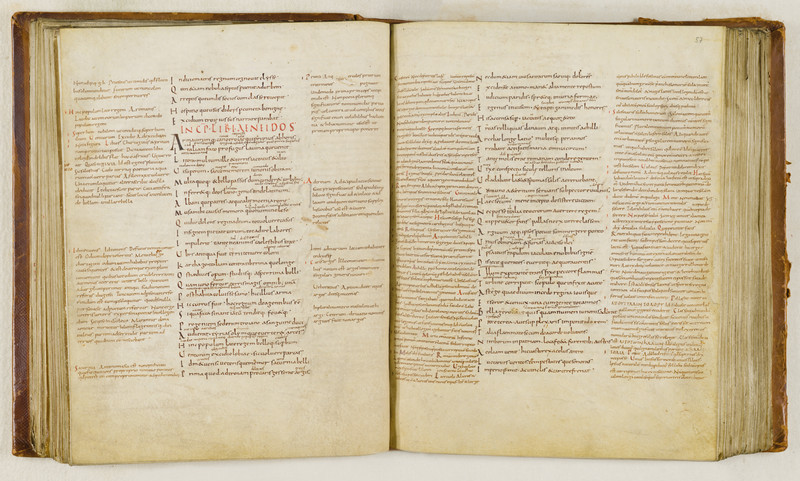
    Staats- und Universitätsbibliothek Hamburg

    A codex written in the 9th century in France. Shelfmark: Cod. in scrin. 52

    The term codex (used in English since 1661, according to OED) is a borrowing from Latin caudex, originally meaning wood block (Lewis and Short 1879, s.v. ‘caudex’), thus hinting at a possible origin of the codex form as a gathering of wood tablets, much like Paris, Louvre, MNE 914.7 (see Tablet and Book). In later Greek the word κώδιξ (kōdix) / κώδηξ (kōdēx), borrowed from Latin, primarily meant a “code” of laws. The term “codicology” usually indicates the study of the material aspects of books, and not only of codices.

    Based on the type of ‘western’ manuscripts that is usually labelled as codex, Muzerelle defines this form as a “book made up of sheets folded in half and assembled into one or more quires stitched together with a thread along the fold” (Muzerelle 2002–2003, s.v. codex; Macé’s translation). In the context of the present definition of codex, therefore, the characterising feature is the presence of quires (vs Book) – the literature is yet to reach an agreement in this respect, though (cf. Andrist and Maniaci 2021; updating Andrist, Canart and Maniaci 2013, 45–48). Such ‘western’ codex emerged towards the beginning of the so-called “common era” and rapidly became the dominant book form around the Mediterranean and in the areas influenced by the Greco-Latin culture (Maniaci 2015), i.e. the Roman and Byzantine empires, the Christian oriental cultures, the Slavs, the Manicheans and the Arab-Islamic world, with percolations into the Hindu, Sikh and Jain traditions in India. By contrast the Jews continued to use the volumen up to the end of the ninth century CE (Beit-Arié 2021, 44; see Scroll/Roll). On the origin of the codex in the West, see Turner 1977, Roberts and Skeat 1987, Blanchard 1989.

    In China the codex made its appearance at the latest in the ninth century, almost certainly due to contacts with ‘western’ cultures via Central Asia (Galambos 2020, 12): part of the Dunhuang codices were in fact sewn/stitched and structurally identical to ‘western’ codices, The oldest dated Chinese example is from 899 CE, but some of the undated codices might even be from the eighth century CE (Drège 1979, 17–18).

    As only a limited number of materials offering a writing surface can be folded and stitched, a codex is de facto made of papyrus, parchment, paper or bark, and these materials are normally inscribed with black and coloured inks. Although the codex form continued to be used in the printed world up to today, the word “codex” is normally used for handwritten books only.

    Because it is possible to dismantle and rebind it, the codex is possibly a modular and evolving object, made of “codicological units” (folio, bifolio, quire) that may have different fate and circulation. See Andrist and Maniaci’s Syntax of the Codex (Andrist and Maniaci 2021; updating Andrist, Canart and Maniaci 2013).

    References

    • Andrist, P., P. Canart and M. Maniaci (2013), La syntaxe du codex: Essai de codicologie structurale, Turnhout: Brepols.
    • Andrist, P. and M. Maniaci (2021), ‘La Syntaxe du codex huit ans après: Mises à jour terminologiques à propos du “codex” et du “Bifolio”’, in M. D’agostino and L. Pieralli (eds), Φιλόδωρος εὐμενείας. Miscellanea di studi in ricordo di Mons. Paul Canart, Vatican City: Scuola Vaticana di Paleografia, Diplomatica e Archivistica, 21–28.
    • Beit-Arié, M. (2021), Hebrew Codicology: Historical and Comparative Typology of Medieval Hebrew Codices based on the Documentation of the Extant Dated Manuscripts until 1540 using a Quantitative Approach, Jerusalem/Hamburg: The Israeli Academy of Sciences and the Humanities, <https://doi.org/10.25592/uhhfdm.9349>. 
    • Blanchard, A. (1989), Les débuts du codex: Actes de la journée d’étude organisée à Paris les 3 et 4 juillet 1985 par l’Institut de Papyrologie de la Sorbonne et l’Institut de Recherche et d’Histoire des Textes, Turnhout: Brepols.
    • Drège, J.-P. (1979), ‘Les cahiers des manuscrits de Touen-Houang’, in M. Soymié (ed.), Contributions aux études sur Touen-Houang, Geneva: Droz,17–28.
    • Galambos, I. (2020), Dunhuang Manuscript Culture: End of the First Millennium, Berlin/Boston: De Gruyter <https://doi.org/10.1515/9783110726572>. 
    • Helliwell, D. (1998), ‘The repair and binding of old Chinese books: Translated and adapted for western conservators’, The East Asian Library Journal,8/1, 27–149.
    • Lewis, C. T. and C. Short (1879), A Latin Dictionary. Founded on Andrews’ Edition of Freund’s Latin Dictionary. Revised, Enlarged, and in Great Part Rewritten, Oxford: Clarendon Press. 
    • Maniaci, M. (2015), ‘Book forms’ and ‘The making of the codex’, in A. Bausi, P. G. Borbone, F. Briquel-Chatonnet, P. Buzi, J. Gippert, C. Macé, M. Maniaci, Z. Melissakis, L. E. Parodi, W. Witakowski and E. Sokolinski (eds), Comparative Oriental Manuscript Studies: An Introduction, Hamburg: Tredition, 77–84 <https://doi.org/10.5281/zenodo.46784>. 
    • Muzerelle, D. (2002–2003), ‘Index des termes’, Codicologia, Institut de recherche et d'histoire des textes <https://codicologia.irht.cnrs.fr/indexc> (accessed 2 Aug. 2024). 
    • Oxford English Dictionary [OED], s.v. ‘codex (n.),’ July 2023 <https://doi.org/10.1093/OED/1034670662>. 
    • Roberts, C. H. and T. C. Skeat (1987), The Birth of the Codex, London: Oxford University Press [1st edn 1983].
    • Turner, Eric G. (1977), The Typology of the Early Codex, Philadelphia: University of Pennsylvania Press <https://doi.org/10.9783/9781512807868>. 
    • alt-types

    • Board
    • Book
    • Codex
      • Concertina
      • Cylinders, Prisms, Triangular dockets
      • Folio
      • Garments, Tapestry, and Textile Items
      • Label
      • Letter and Envelope
      • Ostracon
      • Plate
      • Pothi
      • Scroll/Roll
      • Slab
      • Tablet
      • Tattoos and Scarification
      • Unfashioned Written Artefacts

      Last update: 2 September 2024

      • Feedback
      • Legal notice
      • Privacy statement
      • Accessibility
      • Site map

      University of Hamburg

      Innovating and Cooperating for a Sustainable Future in a Digital Age

      • Follow us on Instagram.
      • Follow us on Facebook.
      • Connect with us on LinkedIn.
      • Follow us on Mastodon.
      • Follow us on Bluesky.
      • Subscribe to our channel on YouTube.
        • Studies
        • Prospective students
        • Continuing education
        • Research
        • Teaching at UHH
        • Doctoral studies
        • Job opportunities
        • Knowledge exchange
        • University
        • Excellence
        • Faculties
        • Alumni
        • Contact
        • Campus Navigator
        • UHHApp
        • Emergencies, safety and security
        • Antidiscrimination
      Go to family-friendly higher education institution audit
      Go to internationalisation re-audit
      Go to the Sustainability Audit page
      Go to Diversity Audit
      Go to System accreditation

      © 2026 University of Hamburg. All rights reserved