• Zur Metanavigation
  • Zur Hauptnavigation
  • Zur Suche
  • Zum Inhalt
  • Zur Subnavigation
  • Zum Seitenfuß
  • University of Hamburg
  • For journalists
  • Staff Service Portal0
  • STiNE
https://www.kus.uni-hamburg.de/aktuelles.json?recentnews=true
  • Institutions and target groups
    • Einrichtungen
      • Faculties

        • Faculty of Law
        • Faculty of Business, Economics and Social Sciences
        • Faculty of Medicine
        • Faculty of Education
        • Faculty of Humanities
        • Faculty of Mathematics, Informatics and Natural Sciences
        • Faculty of Psychology and Human Movement Science
        • University of Hamburg Business School
      • Services

        • Study Information Net STiNE
        • Surfmail
        • Exchange
        • Staff Service Portal
        • Learning Platforms
        • Katalogplus – Catalogue of Hamburg Libraries
        • SharePoint
      • Student facilities and services

        • Campus Center
        • Career Center
        • PIASTA
        • AStA (student council)
        • University Sports
        • University Music
        • Family Office
        • University Language Center
        • General Languages
        • Office of Affairs for Students with Disabilities or Chronic Diseases
        • Departmental libraries
        • Healthy Campus
      • Further facilities and services

        • The Cluster of Excellence CLICCS
        • The Cluster of Excellence CUI
        • The Cluster of Excellence Quantum Universe
        • The Cluster of Excellence Understanding Written Artefacts
        • Hamburg Research Academy
        • Pier Plus
        • Hamburg Center for University Teaching and Learning (HUL)
        • Hub for Crossdisciplinary Learning (HCL)
        • CEN
        • Museums and collections
        • University Archives (in German)
        • Regional Computing Center (RRZ)
        • University Administration
        • Knowledge Exchange Agency
        • The Unikontor Shop (in German)
    • Target groups

      • Prospective students
      • Students
      • International prospective students
      • Young researchers
      • Researchers
      • Instructors
      • Staff
      • Prospective continuing education students
      • Alumni
      • Journalists
      • Refugees (in German only)
    Close
  • /sitemap.json
University of Hamburg - to research, to teach, to educate and form, to homepage
profiling-guide-alt

    Photo: CSMC

    1. UHH
    2. CSMC
    3. profiling-guide-alt
    4. alt-materials
    5. Writing Surfaces
    6. Bone and seashell

    Bone and seashell

    CSMC Collection

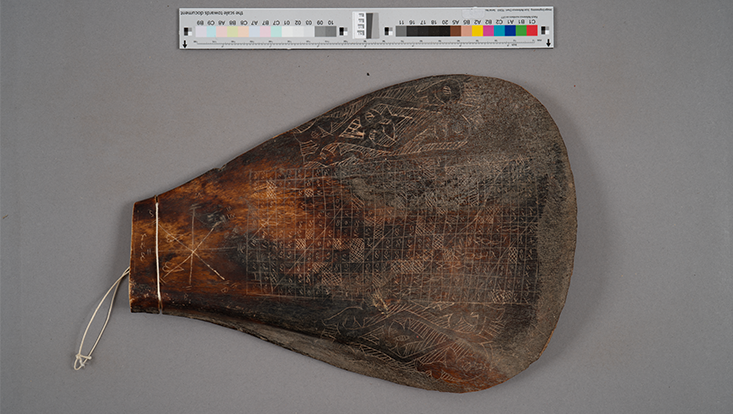
    Shoulder blade with Batak writing and symbols from Indonesia.

    Animal bones, including elephant tusks and tortoise shells (mostly the lower part called plastron), as well as seashells can be used as writing supports without the need for any particular fashioning (vs e.g. bone Tablets or ivory folios in Pothis). They can be both carved or painted.

    Examples can be found in virtually all cultures. Notably, bones and shells are together with rocks (see Tools) the earliest extant objects in human history to have been manipulated (one may say etched, rather than inscribed) so as to bear signs. For example, shells from Java (Indonesia) dating back to 500.000 years ago (Joordens et al. 2015) and white-tailed eagle talons from Croatia dating back to 130.000 years ago (Radovcic et al. 2015).

    In historic times, a notorious case is surely that of the so-called “oracle bone inscriptions” (甲骨文, jiǎgǔwén) produced in particular between the fourteenth and the eleventh century BCE, at the time of the Shang dynasty (Keightley 1978, 6–9). Once cleaned from flesh and smoothed, ox scapulae and tortoise undershells were used for acts of pyromancy (called scapulimancy and plastromancy, respectively) that included some writing.

    References

    • Albéric, Marie ; Reiche, Ina (2015), «Ivoire», in Balasse, Marie ; Brugal, Jean-Philippe ; Dauphin, Yannicke (dir.), Messages d'os. Archéométrie du squelette animal et humain., Editions des archives contemporaines, Coll. «Sciences archéologiques», France, ISBN : 9782813001641, pp. 53-72, doi : https://doi.org/10.17184/eac.3981
    • Joordens, Josephine, Francesco d’Errico, Frank P. Wesselingh et al. (2015), ‘Homo erectus at Trinil on Java used shells for tool production and engraving’, in Nature 518, 228–231. https://doi.org/10.1038/nature13962
    • Keightley, David N. (1978), Sources of Shang History: The Oracle-Bone Inscriptions of Bronze Age China, Berkeley/Los Angeles: University of California Press.
    • Radovčić, Davorka, Ankica Oros Sršen, Jakov Radovčić and David W. Frayer (2015), ‘Evidence for Neandertal Jewelry: Modified White-Tailed Eagle Claws at Krapina’, in PLoS ONE 10(3): e0119802. https://doi.org/10.1371/journal.pone.0119802
    • Yuho, Tseng (1998), A History of Chinese Calligraphy, Hong Kong: Chinese University Press.
    • alt-materials

    • Writing Surfaces
      • Bone and seashell
        • Clay and Pottery
        • Leather and Parchment
        • Metal
        • Paper
        • Paper-like Materials
        • Papyrus
        • Rocks and Minerals
        • Silk
        • Tapa cloth and Amate paper
        • Textile
        • Tree Bark
        • Wax
        • Wood
      • Writing Substances

      Last update: 23 August 2024

      • Feedback
      • Legal notice
      • Privacy statement
      • Accessibility
      • Site map

      University of Hamburg

      Innovating and Cooperating for a Sustainable Future in a Digital Age

      • Follow us on Instagram.
      • Follow us on Facebook.
      • Connect with us on LinkedIn.
      • Follow us on Mastodon.
      • Follow us on Bluesky.
      • Subscribe to our channel on YouTube.
        • Studies
        • Prospective students
        • Continuing education
        • Research
        • Teaching at UHH
        • Doctoral studies
        • Job opportunities
        • Knowledge exchange
        • University
        • Excellence
        • Faculties
        • Alumni
        • Contact
        • Campus Navigator
        • UHHApp
        • Emergencies, safety and security
        • Antidiscrimination
      Go to family-friendly higher education institution audit
      Go to internationalisation re-audit
      Go to the Sustainability Audit page
      Go to Diversity Audit
      Go to System accreditation

      © 2026 University of Hamburg. All rights reserved